
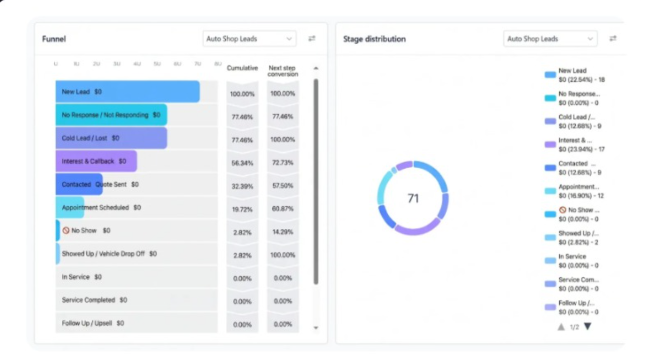
CRM pipeline management sounds like back-office plumbing until you actually watch what happens without it; leads come in, someone gets busy, a follow-up never goes out, and the business never finds out a booking slipped away. That's exactly where this auto shop client stood before we stepped in. Once we built out a proper pipeline for them, 71 leads suddenly had a visible story attached to every single one, and that story revealed exactly where the money was getting stuck.
A Shop Full of Leads, Not Enough Visibility
This auto shop wasn't short on leads. New inquiries came in steadily from ads, calls, and word of mouth. The problem was that nobody could say, with any confidence, what happened to a lead after it landed. Did the front desk call back? Did the quote go out? Did the customer just ghost, or did the shop drop the ball? Without a real system tracking each stage, every answer was a guess dressed up as an educated one.
That's the exact gap a solid CRM pipeline management setup is built to close. Instead of leads living in someone's memory or a scattered spreadsheet, every one of them now moves through a defined funnel, stage by stage, with a number attached at every step.
“Pouring more leads into a funnel with a known leak just means losing more customers faster. True growth starts when every stage of your pipeline becomes fully visible.”
Building a Funnel That Actually Tells the Truth
We mapped out the shop's real customer journey: New Lead, then either No Response or a genuine Interest and Callback, moving into Contacted and Quote Sent, then an Appointment Scheduled, and finally either a No Show or a real Showed Up before heading into service and, eventually, a Follow Up or Upsell. Nothing exotic, just an honest reflection of how a customer actually moves from first inquiry to a vehicle in the bay.
The value wasn't in making the funnel look impressive. It was in making sure every one of those 71 leads landed in a stage that told the truth about where things stood, so the shop could finally see its own sales funnel tracking instead of relying on gut feeling.
Where the Pipeline Was Actually Leaking
Once the data started flowing, the story got interesting fast. Of those 71 leads, 22.54% sat fresh as New Leads and another 23.94% had moved into Interest and Callback, meaning nearly half the pipeline was still warm and worth working. But look at the next step conversion rates and the leaks show up clearly: only 57.50% of contacted leads moved on to get an appointment scheduled, and once an appointment was booked, a striking number of those customers simply didn't show up.
In fact, Showed Up and No Show sat at the exact same 2.82% of the total pipeline, which means for every customer who actually walked through the door, another one who booked an appointment never did. That's not a marketing problem. That's a lead conversion tracking problem, and it's one you can only fix once you can actually see it.
Why Seeing the Leak Matters More Than Chasing More Leads
Plenty of businesses respond to a stall in bookings by spending more on ads to generate more leads. Sometimes that's the right call. Here, it clearly wasn't. This shop didn't have a lead shortage, it had a follow-through problem sitting right between Quote Sent and Appointment Scheduled, and another one between Appointment Scheduled and actually Showing Up. Pouring more leads into a funnel with a known leak just means losing more customers at the same broken point, faster.
That's the real argument for CRM automation for auto shops and businesses like it: it doesn't just organize your leads, it shows you precisely which stage of your own sales pipeline visibility is costing you money, so every future dollar spent on marketing actually has somewhere solid to land.
What This Means for Your Own Pipeline
If your business tracks leads the old way, through memory, sticky notes, or a spreadsheet nobody updates consistently, you likely have a version of this same leak hiding somewhere in your funnel. You won't know where until the data is structured well enough to show you. That's exactly what a CRM pipeline management system built to catch every leak does for a business, whether you're running an auto shop, a service company, or anything in between with a multi-step sales process.
Turning Visibility Into Real Bookings
This shop went from guessing what happened to their leads to knowing, stage by stage, exactly where 71 real customers stood at any given moment. That single shift, from guesswork to visibility, is usually the first and biggest win in fixing a leaky funnel. The optimization work comes next, but none of it is possible without seeing the leak first. If your pipeline feels like it's swallowing leads without explanation, let's get it mapped out and find out exactly where they're going.